Sunday, November 16, 2008

Review of EL GRAN DÍA DE LILY (LILLY’S BIG DAY)

Henkes, Kevin. 2006 (Spanish translation, 2008). EL GRAN DÍA DE LILY. New York: Greenwillow Books. ISBN 978061363160

Lily is back and is as precocious and self-assured as ever. The young mouse best known for her purple plastic purse and movie star glasses now has designs on being the flower girl, la damita de honor, at her teacher’s wedding. Needless to say, Lily is not pleased when she learns that Mr. Slinger’s niece, rather than herself, has been selected. Readers will enjoy watching Lily make lemonade out of lemons as she copes with her disappointment and accepts Mr. Slinger’s concession.

Henkes continues to capture this young mouse’s voice with precision. He uses dialogue, illustrations and text position to emphasize Lily’s signature perseverance. Even after her parents explain to Lily she is not likely to be Mr. Slinger’s choice, Lily confirms to herself, “…I’m going to be the flower girl.” Further, Henkes emphasizes Lily’s commitment to proper flower girl etiquette by using 18 mini-illustrations on a two-page spread!

The Spanish translation of the text flows well with few unfamiliar words. The terms “tarareó” and “aula” are not commonly used among our school’s population. However, Henkes’ skillful use of context clues facilitates comprehension as well as vocabulary lessons. Criticas says, “the translation sparkles” and Horn Book notes “seeing this book in Spanish is a reminder that a good translation, such as this one, can make a story transcend language barriers.”
Recommended use: read aloud, story time, or independent picture walks for readers ages 5-9 years.

Review of UN LEON EN LA BIBLIOTECA (LIBRARY LION)


Knudsen, Michelle. Kevin Hawkes (Ill.) 2006 (Spanish translation, 2007). UN LEÓN EN LA BIBLIOTECA. New York: Lectorum. ISBN 978-1-933032-30-6

How important are rules? If the rules don’t apply, then what? As a lion walks through the library sniffing and rubbing, El Señor McBee wonders just that. The wise librarian, Señora Buendía, responds, “déjelo estar” (let him stay). This thoughtful story challenges readers to consider, “When is it ok to break the rules?”

Hawkes’ acrylic and pencil illustrations use soothing, muted tones reflecting the calm library environment. Even the text is a light brown shade rather than the traditional black. When the lion leaves, the text and illustrations make it evident he is missed—down to the wilting plant in the window. Throughout the story, wide-open eyes and mouths agape emphasize the text’s meaning. Señor McBee’s scowling face reveals a jealousy at which the words merely hint and text within the illustrations emphasizes the vehemence of Lion’s roar.

The Spanish translation of the text flows well with few unfamiliar terms. The phrase “mostrador de préstamo” (circulation desk) is new to me, but familiar to a colleague from Monterrey, Mexico. Teresa Mlawer’s translation uses formal yet accessible Spanish to relay Knudsen’s story. Criticas says, “kids will be drawn to [the lion], to the library, and to storytime.”

Recommended use: read aloud, story time, or independent picture walks for readers ages 5-9 years. Good story for beginning of the year “Rules” lesson or “How to respond in an emergency” lesson.

Thursday, May 1, 2008

Review of SNAKES

Gibbons, Gail. 2007. SNAKES. New York: Holiday House. ISBN 0-8234-2122-8

Historically, snakes have been seen as gods and symbols of health. But today, the mention of snakes makes many people’s skin crawl—even though most of the 3,000 kinds of snakes are harmless to humans. Gibbons hits yet another homerun with this accurate, well-organized, and informative book on snakes. Though somewhat cartoonish, Gibbons illustrations are accurate and labeled with the name and geographic region of each snake. A color-coded world map highlights the areas which snakes inhabit. The short text blocks include easy-to-read sentences which are supported by the corresponding pictures. This style facilitates reader comprehension. Gibbons’ use of complete sentences in her captions also models proper writing form. Specific information in this book is easily found by using the bold, consistently located headings. In order to share tidbits about snakes which did not fit into a heading, a fact page is included. There is neither an additional resources section nor a bibliography in SNAKES. This leads the reader to independent research, though a few hints would have been nice.

This informational resource on snakes is recommended for readers ages 5-10.

Tuesday, April 29, 2008

Review of NATIONAL WILDLIFE FEDERATION’S YOUR BIG BACKYARD

National Wildlife Federation. May 2008. YOUR BIG BACKYARD, 12(5). ISSN 0886-5299

From photographs and articles to games and recipes, this magazine for young animal enthusiasts has something for everyone! Published by the National Wildlife Federation, YOUR BIG BACKYARD contains accurate information on all types of animals. Each issue has a theme on which all pieces focus—May’s theme is Meet the Kids. It includes information on the appearance, habitat, and other characteristics of baby animals. Interspersed among the informational text are rebus stories, mazes, a pull-out poster and the Find Bonnie game. Many of the features, such as kid-friendly recipes, recur throughout the year. This provides a comforting sense of predictability for young children. Interaction between the reader and her caregiver is encouraged by including such things as shared reading stories, the use of questioning, as well as crafts. Every item in the magazine is outlined in a clear, attractive table of contents using both words and pictures to help readers find articles. The articles themselves are marked with page numbers and an easily recognizable title. In addition, pictures support new readers by having well-matched captions. The voice is right on target for this magazine’s intended audience. Though anthropomorphism is found throughout the issue, it is reflective of how many young children perceive and interact with animals. Short articles and stories, succinct sentences, and opportunities for interaction make YOUR BIG BACKYARD a hit month after month.

This magazine is highly recommended for animal enthusiasts ages 3-6.

Sunday, April 27, 2008

Review of A PICTURE BOOK OF DWIGHT DAVID EISENHOWER

Adler, David A. 2002. A PICTURE BOOK OF DWIGHT DAVID EISENHOWER. New York: Holiday House. ISBN 09-8234-1702-6

Ever heard, “I like Ike” and “I still like Ike?” From this picture book biography, the reader can assume that David Adler still likes Ike too. This biography of Dwight Eisenhower is one in a series of over 30 picture book biographies Adler has written. Though easy to read, entertaining and packed with original photographs, alas this book falls into the trap of glorifying its subject. Though a praiseworthy man, the litany of compliments, including “brilliant leadership,” “friendly and popular in school,” “natural leader,” and “superior student,” seem a bit like overkill—as compared to the modest admission that “sometimes he lost his temper.” This glorification notwithstanding, A PICTURE BOOK OF DWIGHT DAVID EISENHOWER is most likely an accurate depiction of his life. In the verso, the executive director of The Eisenhower Foundation praises the book as a “factual pictoral biography.” Reference aids include a time line of important dates and an interesting and informative author’s note. Though many pieces of Eisenhower’s life are introduced, much is left unsaid. Few details of his war experience and his presidency are discussed. An interested reader could use the selected bibliography and recommended websites sections to fill in the gaps. With bestselling books to his credit, Adler is clearly a talented writer. However, I can’t help but wonder, what would Adlai Stevenson have to add to this biography?

This picture book biography is recommended for readers ages 6-10.

Saturday, April 26, 2008

Review of THE BROOK BOOK: EXPLORING THE SMALLEST STREAMS

Arnosky, Jim. 2008. THE BROOK BOOK: EXPLORING THE SMALLEST STREAMS. Westport, CT: Dutton Children’s Books. ISBN 9-780525-477167

Mayflies begin their lives here while some fish and wildflowers spend their whole lives here. The chickadee and muskrat depend on it for survival. Brooks can be interesting places and Jim Arnosky sets out to ensure readers of his book know why. With sections on insects, amphibians, plants, fish and more; the reader learns about what can be found in and around brooks and how best to appreciate those things. With particular focus on study and preservation, Arnosky includes strategies for having the least negative impact on this fragile ecosystem. His tone is informative and instructional without being patronizing. Detailed information such as the materials used by the Caddis flies to build their cases sets THE BROOK BOOK apart from other more general books on water ecosystems. The realistic illustrations are labeled and often accompanied by a life-sized silhouette, giving readers a sense of dimension and perspective. An author’s note geared toward teachers encourages the use of brooks as an outdoor learning environment. Also included is a bibliography of resources for additional study on brooks. This piece of informational literature has neither a table of contents nor an index, though its organization lends itself to the use of both. Unfortunately, if the reader is in search of a specific piece of information about brooks, he or she must either browse or read the entire book.

This informational resource on brooks is appropriate for readers ages 5-9.

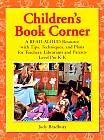
Review of CHILDREN’S BOOK CORNER: A READ-ALOUD RESOURCE WITH TIPS, TECHNIQUES, AND PLANS FOR TEACHERS, LIBRARIANS AND PARENTS LEVEL PRE-K-K

Bradbury, Judy. 2003. CHILDREN’S BOOK CORNER: A READ-ALOUD RESOURCE WITH TIPS, TECHNIQUES, AND PLANS FOR TEACHERS, LIBRARIANS AND PARENTS LEVEL PRE-K-K. Westport, CT: Libraries Unlimited. ISBN 1-59158-048-X

Judy Bradbury has to her credit a set of handbooks geared toward helping teachers, librarians, and parents in their quest for great read-alouds. This series covers Pre-K through the sixth grade. For the purpose of this review, the Pre-K - Kindergarten volume is referenced. CHILDREN’S BOOK CORNER includes lesson plans for fifty-three different picture books with copyrights ranging from 1942 to 2002. Also included are “pull-out pages” for parents. These pages include tips for parents as well as lists of additional theme-related, age-appropriate trade books. These lists are organized not only by subject, but also by type of book. This includes wordless, poetry and teacher resource books.

This book’s strongest asset is the sheer number of read-aloud lesson plans included. With fifty-three stories, one could read a story per week for a whole year! These lesson plans use classic titles such as GREEN EGGS AND HAM by Dr. Seuss. Bradbury also includes more contemporary books, including Amy Hest’s KISS GOODNIGHT. These lesson plans include critical pieces of information: knowing how long a story takes to read; pre-reading activities used to access children’s prior knowledge; techniques to use while reading the story; follow-up discussion questions and activities; and paired titles (“another book about…is…”). Beyond these thoughtful lesson plans, the author provides a brief description of the elements of a good picture book. In addition, children’s book awards and book review resources, such as The Horn Book Magazine, www.ala.org, and Jim Trelease’s THE NEW READ-ALOUD HANDBOOK, are listed.

Though a useful resource, CHILDREN’S BOOK CORNER has its weaknesses. For example, the copyright on many of the picture books referenced are old—some as old as 1942 (THE RUNAWAY BUNNY by Margaret Brown). While the majority of the books are not 66 years old, most titles are pre-1990. Another of the weaknesses has to do with the photographs included in this resource. Often, there is an unclear connection between the read-aloud plans and the adjacent photos. In one instance, the photographs show an adult and child reading ROSIE’S WALK. However, the photographs are adjacent to the read-aloud plans for BOOTSIE BARKER BITES. The lesson plan for ROSIE’S WALK is later in the book. Perhaps it is because the publisher did not acquire permission to print the covers of these books, necessitating the use of other types of photographs. In my opinion, this particular weakness provokes an amateurish impression. It’s as though the publisher was too lazy to procure permission to use the front covers for the rest of the titles.

Other weak points in this book are not what it includes, rather what it excludes. CHILREN’S BOOK CORNER lacks consistent and complete bibliographic information among the read-aloud titles. Bradbury includes the title, author, illustrator and publisher for each title. Yet, most titles lack the copyright date and none have ISBNs. Other omissions include consistent incorporation of front cover pictures, paired book suggestions, and the books’ classification, i.e. whether a book is Easy or Nonfiction. While the call number might be considered superfluous or an unrealistic expectation, knowing the type of book would be helpful in terms of searching for it. For example, it is unclear if I LOVE TRAINS! is found in the Easy or Nonfiction section of a library or bookstore.

Bradbury is careful to include a complete citation for each book for which a front cover picture is shown. The acquisition of publisher permission is made clear by the consistent use of the phrase “used with permission.” A formal citation for each read-aloud book, however, is not provided. The bibliographic information which is provided is in a table preceding each lesson plan. There is no formal bibliography anywhere in the resource.

The informal, conversational voice makes CHILDREN’S BOOK CORNER easy to read and understand. The book is broken into manageable sections which are delineated by intended audience: teachers and librarians, parents or both. Non-professional educators need not worry about the use of technical terminology nor confusing educational strategies. The teacher/librarian and parent sections contain duplicate information, each with an audience-specific tone. Bold headings facilitate the location of specific information. Another helpful access feature is the inclusion of four different indices. Readers can search by subject, title, author, and illustrator. Bradbury also provides an appendix of “…books too good to miss (but-wouldn’t-fit-in-the-main-section).” These titles are arranged by topic.

This resource speaks to a wide audience—virtually anyone who works with young children. All teachers who work with preschool through kindergarten-aged children would benefit from the information in this book. For librarians who have Easy collections in their libraries, this is an essential title. Finally, parents, grandparents, babysitters—in effect any caregiver of young children—could use these lesson plans to make story time a richer learning experience.

This resource is highly recommended for teachers, librarians, caregivers and parents of children ages 2-6.