Showing posts with label children's literature. Show all posts

Wednesday, November 26, 2008

Review of FOUR LEGS BAD, TWO LEGS GOOD!

Johnson, D.B. 2007. FOUR LEGS BAD, TWO LEGS GOOD! Boston: Houghton Mifflin Company. ISBN 978-0-618-80909-7. $16.00.

While most of the animals of the No-Man Farm are working hard to keep it running, Orvie the pig is not. When Duck discovers Orvie is a lazy despot rather than a hard-working farmer, he decides to do something about it. Duck pulls the plug on their routine challenging the validity of the way things are.

Johnson’s layout includes Picasso-like, mixed media illustrations and hand-lettered text. Many pages are presented in a series of comic book frames and conversations are presented in speech bubbles. This format is likely to hold young readers’ attention by illustrating sequencing and dialog. Though this book may prove to be over the heads of its primary audience, its usefulness is clear. The lazy pig and pestering duck are sure to strike a chord with young children. Give this book several readings if you want to catch all the details creatively peppered throughout its pages.

“Slightly cubist, cartoon-like illustrations in mixed media capture the lighthearted politics of this comic animal farm.” (Kirkus Review, 2007)
“…More than a few adults sharing it with kids will be tempted to revisit the classic.” (School Library Journal, 2007)

Recommended use: Read aloud, story time, or independent reading for children ages 5-12 years. This is a good story for discussing team work and equality as well as more weighty topics such as oppression and prejudice.

Sunday, November 16, 2008

Review of EL GRAN DÍA DE LILY (LILLY’S BIG DAY)

Henkes, Kevin. 2006 (Spanish translation, 2008). EL GRAN DÍA DE LILY. New York: Greenwillow Books. ISBN 978061363160

Lily is back and is as precocious and self-assured as ever. The young mouse best known for her purple plastic purse and movie star glasses now has designs on being the flower girl, la damita de honor, at her teacher’s wedding. Needless to say, Lily is not pleased when she learns that Mr. Slinger’s niece, rather than herself, has been selected. Readers will enjoy watching Lily make lemonade out of lemons as she copes with her disappointment and accepts Mr. Slinger’s concession.

Henkes continues to capture this young mouse’s voice with precision. He uses dialogue, illustrations and text position to emphasize Lily’s signature perseverance. Even after her parents explain to Lily she is not likely to be Mr. Slinger’s choice, Lily confirms to herself, “…I’m going to be the flower girl.” Further, Henkes emphasizes Lily’s commitment to proper flower girl etiquette by using 18 mini-illustrations on a two-page spread!

The Spanish translation of the text flows well with few unfamiliar words. The terms “tarareó” and “aula” are not commonly used among our school’s population. However, Henkes’ skillful use of context clues facilitates comprehension as well as vocabulary lessons. Criticas says, “the translation sparkles” and Horn Book notes “seeing this book in Spanish is a reminder that a good translation, such as this one, can make a story transcend language barriers.”
Recommended use: read aloud, story time, or independent picture walks for readers ages 5-9 years.

Thursday, May 1, 2008

Review of SNAKES

Gibbons, Gail. 2007. SNAKES. New York: Holiday House. ISBN 0-8234-2122-8

Historically, snakes have been seen as gods and symbols of health. But today, the mention of snakes makes many people’s skin crawl—even though most of the 3,000 kinds of snakes are harmless to humans. Gibbons hits yet another homerun with this accurate, well-organized, and informative book on snakes. Though somewhat cartoonish, Gibbons illustrations are accurate and labeled with the name and geographic region of each snake. A color-coded world map highlights the areas which snakes inhabit. The short text blocks include easy-to-read sentences which are supported by the corresponding pictures. This style facilitates reader comprehension. Gibbons’ use of complete sentences in her captions also models proper writing form. Specific information in this book is easily found by using the bold, consistently located headings. In order to share tidbits about snakes which did not fit into a heading, a fact page is included. There is neither an additional resources section nor a bibliography in SNAKES. This leads the reader to independent research, though a few hints would have been nice.

This informational resource on snakes is recommended for readers ages 5-10.

Tuesday, April 29, 2008

Review of NATIONAL WILDLIFE FEDERATION’S YOUR BIG BACKYARD

National Wildlife Federation. May 2008. YOUR BIG BACKYARD, 12(5). ISSN 0886-5299

From photographs and articles to games and recipes, this magazine for young animal enthusiasts has something for everyone! Published by the National Wildlife Federation, YOUR BIG BACKYARD contains accurate information on all types of animals. Each issue has a theme on which all pieces focus—May’s theme is Meet the Kids. It includes information on the appearance, habitat, and other characteristics of baby animals. Interspersed among the informational text are rebus stories, mazes, a pull-out poster and the Find Bonnie game. Many of the features, such as kid-friendly recipes, recur throughout the year. This provides a comforting sense of predictability for young children. Interaction between the reader and her caregiver is encouraged by including such things as shared reading stories, the use of questioning, as well as crafts. Every item in the magazine is outlined in a clear, attractive table of contents using both words and pictures to help readers find articles. The articles themselves are marked with page numbers and an easily recognizable title. In addition, pictures support new readers by having well-matched captions. The voice is right on target for this magazine’s intended audience. Though anthropomorphism is found throughout the issue, it is reflective of how many young children perceive and interact with animals. Short articles and stories, succinct sentences, and opportunities for interaction make YOUR BIG BACKYARD a hit month after month.

This magazine is highly recommended for animal enthusiasts ages 3-6.

Sunday, April 27, 2008

Review of A PICTURE BOOK OF DWIGHT DAVID EISENHOWER

Adler, David A. 2002. A PICTURE BOOK OF DWIGHT DAVID EISENHOWER. New York: Holiday House. ISBN 09-8234-1702-6

Ever heard, “I like Ike” and “I still like Ike?” From this picture book biography, the reader can assume that David Adler still likes Ike too. This biography of Dwight Eisenhower is one in a series of over 30 picture book biographies Adler has written. Though easy to read, entertaining and packed with original photographs, alas this book falls into the trap of glorifying its subject. Though a praiseworthy man, the litany of compliments, including “brilliant leadership,” “friendly and popular in school,” “natural leader,” and “superior student,” seem a bit like overkill—as compared to the modest admission that “sometimes he lost his temper.” This glorification notwithstanding, A PICTURE BOOK OF DWIGHT DAVID EISENHOWER is most likely an accurate depiction of his life. In the verso, the executive director of The Eisenhower Foundation praises the book as a “factual pictoral biography.” Reference aids include a time line of important dates and an interesting and informative author’s note. Though many pieces of Eisenhower’s life are introduced, much is left unsaid. Few details of his war experience and his presidency are discussed. An interested reader could use the selected bibliography and recommended websites sections to fill in the gaps. With bestselling books to his credit, Adler is clearly a talented writer. However, I can’t help but wonder, what would Adlai Stevenson have to add to this biography?

This picture book biography is recommended for readers ages 6-10.

Saturday, April 26, 2008

Review of THE BROOK BOOK: EXPLORING THE SMALLEST STREAMS

Arnosky, Jim. 2008. THE BROOK BOOK: EXPLORING THE SMALLEST STREAMS. Westport, CT: Dutton Children’s Books. ISBN 9-780525-477167

Mayflies begin their lives here while some fish and wildflowers spend their whole lives here. The chickadee and muskrat depend on it for survival. Brooks can be interesting places and Jim Arnosky sets out to ensure readers of his book know why. With sections on insects, amphibians, plants, fish and more; the reader learns about what can be found in and around brooks and how best to appreciate those things. With particular focus on study and preservation, Arnosky includes strategies for having the least negative impact on this fragile ecosystem. His tone is informative and instructional without being patronizing. Detailed information such as the materials used by the Caddis flies to build their cases sets THE BROOK BOOK apart from other more general books on water ecosystems. The realistic illustrations are labeled and often accompanied by a life-sized silhouette, giving readers a sense of dimension and perspective. An author’s note geared toward teachers encourages the use of brooks as an outdoor learning environment. Also included is a bibliography of resources for additional study on brooks. This piece of informational literature has neither a table of contents nor an index, though its organization lends itself to the use of both. Unfortunately, if the reader is in search of a specific piece of information about brooks, he or she must either browse or read the entire book.

This informational resource on brooks is appropriate for readers ages 5-9.

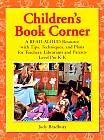
Review of CHILDREN’S BOOK CORNER: A READ-ALOUD RESOURCE WITH TIPS, TECHNIQUES, AND PLANS FOR TEACHERS, LIBRARIANS AND PARENTS LEVEL PRE-K-K

Bradbury, Judy. 2003. CHILDREN’S BOOK CORNER: A READ-ALOUD RESOURCE WITH TIPS, TECHNIQUES, AND PLANS FOR TEACHERS, LIBRARIANS AND PARENTS LEVEL PRE-K-K. Westport, CT: Libraries Unlimited. ISBN 1-59158-048-X

Judy Bradbury has to her credit a set of handbooks geared toward helping teachers, librarians, and parents in their quest for great read-alouds. This series covers Pre-K through the sixth grade. For the purpose of this review, the Pre-K - Kindergarten volume is referenced. CHILDREN’S BOOK CORNER includes lesson plans for fifty-three different picture books with copyrights ranging from 1942 to 2002. Also included are “pull-out pages” for parents. These pages include tips for parents as well as lists of additional theme-related, age-appropriate trade books. These lists are organized not only by subject, but also by type of book. This includes wordless, poetry and teacher resource books.

This book’s strongest asset is the sheer number of read-aloud lesson plans included. With fifty-three stories, one could read a story per week for a whole year! These lesson plans use classic titles such as GREEN EGGS AND HAM by Dr. Seuss. Bradbury also includes more contemporary books, including Amy Hest’s KISS GOODNIGHT. These lesson plans include critical pieces of information: knowing how long a story takes to read; pre-reading activities used to access children’s prior knowledge; techniques to use while reading the story; follow-up discussion questions and activities; and paired titles (“another book about…is…”). Beyond these thoughtful lesson plans, the author provides a brief description of the elements of a good picture book. In addition, children’s book awards and book review resources, such as The Horn Book Magazine, www.ala.org, and Jim Trelease’s THE NEW READ-ALOUD HANDBOOK, are listed.

Though a useful resource, CHILDREN’S BOOK CORNER has its weaknesses. For example, the copyright on many of the picture books referenced are old—some as old as 1942 (THE RUNAWAY BUNNY by Margaret Brown). While the majority of the books are not 66 years old, most titles are pre-1990. Another of the weaknesses has to do with the photographs included in this resource. Often, there is an unclear connection between the read-aloud plans and the adjacent photos. In one instance, the photographs show an adult and child reading ROSIE’S WALK. However, the photographs are adjacent to the read-aloud plans for BOOTSIE BARKER BITES. The lesson plan for ROSIE’S WALK is later in the book. Perhaps it is because the publisher did not acquire permission to print the covers of these books, necessitating the use of other types of photographs. In my opinion, this particular weakness provokes an amateurish impression. It’s as though the publisher was too lazy to procure permission to use the front covers for the rest of the titles.

Other weak points in this book are not what it includes, rather what it excludes. CHILREN’S BOOK CORNER lacks consistent and complete bibliographic information among the read-aloud titles. Bradbury includes the title, author, illustrator and publisher for each title. Yet, most titles lack the copyright date and none have ISBNs. Other omissions include consistent incorporation of front cover pictures, paired book suggestions, and the books’ classification, i.e. whether a book is Easy or Nonfiction. While the call number might be considered superfluous or an unrealistic expectation, knowing the type of book would be helpful in terms of searching for it. For example, it is unclear if I LOVE TRAINS! is found in the Easy or Nonfiction section of a library or bookstore.

Bradbury is careful to include a complete citation for each book for which a front cover picture is shown. The acquisition of publisher permission is made clear by the consistent use of the phrase “used with permission.” A formal citation for each read-aloud book, however, is not provided. The bibliographic information which is provided is in a table preceding each lesson plan. There is no formal bibliography anywhere in the resource.

The informal, conversational voice makes CHILDREN’S BOOK CORNER easy to read and understand. The book is broken into manageable sections which are delineated by intended audience: teachers and librarians, parents or both. Non-professional educators need not worry about the use of technical terminology nor confusing educational strategies. The teacher/librarian and parent sections contain duplicate information, each with an audience-specific tone. Bold headings facilitate the location of specific information. Another helpful access feature is the inclusion of four different indices. Readers can search by subject, title, author, and illustrator. Bradbury also provides an appendix of “…books too good to miss (but-wouldn’t-fit-in-the-main-section).” These titles are arranged by topic.

This resource speaks to a wide audience—virtually anyone who works with young children. All teachers who work with preschool through kindergarten-aged children would benefit from the information in this book. For librarians who have Easy collections in their libraries, this is an essential title. Finally, parents, grandparents, babysitters—in effect any caregiver of young children—could use these lesson plans to make story time a richer learning experience.

This resource is highly recommended for teachers, librarians, caregivers and parents of children ages 2-6.

Thursday, April 17, 2008

Review of THE GREAT REDWALL FEAST

Jacques, Brian. Christopher Denise. (Ill.) 1996. THE GREAT REDWALL FEAST. New York: Puffin Books. ISBN 0-329-21714-3

Of the fifteen plus Redwall books, this one is atypically light-hearted. Written in rhyming prose, Brian Jacques tells a story of abbeymice preparing a surprise feast for the abbot—also a mouse. Luckily for the residents of Redwall, the abbot goes on an unexpected, long walk. As it turns out, he knew all along about the surprise and was intentionally giving the devoted abbeymice an opportunity to prepare “in secret.” Though apparently occurring in medieval times, THE GREAT REDWALL FEAST has no specified era. The setting, the Redwall abbey, is most likely in a fantastic version of Britian. This may be supposed by the dialect reflected in the text, for example using “noice” for nice and “marm” for ma’am. Also, the illustrations show a great castle abbey in a countryside reminiscent of western Europe. The writing style makes this prose difficult to read aloud and tedious to read silently. The target audience, grades K-3 are not likely to have the patience to wade through this lengthy picture book. Older readers may be put off by the juvenile and merry tone of the illustrations and story.

While the illustrations in this story are geared for readers grades K-3, the prose is written at a much higher interest level.

Monday, April 14, 2008

Review of BABYMOUSE: QUEEN OF THE WORLD! and BABYMOUSE: OUR HERO


Holm, Jennifer L. 2005. BABYMOUSE: QUEEN OF THE WORLD! New York: Random House. ISBN 0-375-93229-1

Holm, Jennifer L. 2005. BABYMOUSE: OUR HERO. New York: Random House. ISBN 0-375-93230-5

Babymouse is a space explorer, a private eye, a soldier and a queen. Ok, maybe she’s just an ordinary mouse trying to make it in elementary school. Daydreaming is how Babymouse makes the best of rotten, “typical” situations. With the help of her faithful and supportive best friend, Wilson the Weasel, Babymouse makes it through the hard times and always realizes she’s lucky to be herself. In QUEEN OF THE WORLD!, Babymouse wants to be invited to the slumber party of the ever popular but rude, Felicia Furrypaws. When she discovers the slumber party isn’t as fun as she’d thought it would be, Babymouse goes to Wilson’s house with a humble apology and realizes it is with her best friend that she feels like a queen. In OUR HERO, Babymouse is forced to face her fear of dodgeball in gym class. Ultimately, she finds her inner strength when her friend is hit with the ball by Felicia Furrypaws. “That’s it,” she mutters as she slides across the floor, snatches up the last ball, and “fwacks” Felicia to score the winning shot. These Cinderella moments are typical in the Babymouse series. That’s part of what makes them fun to read. The playfulness is enhanced by frequent conversations between the narrator and Babymouse. Though at times confusing, the irregular format of the pages also gives the book a lively feel. In Babymouse, Jennifer Holm brings a girl-focused graphic novel series to collection development plans. In such a male-dominated genre, this is a wonderful path to travel.

This graphic novel is highly recommended for readers grades 2-5.

Sunday, April 13, 2008

Review of THE CHILDREN OF GREEN KNOWE

Boston, L.M. 1955. THE CHILDREN OF GREEN KNOWE. New York: Harcourt, Inc. ISBN 0-15-202468-9

Toseland must go to live with his great-grandmother, Mrs. Oldknow, for the winter break from school. Though they have never met, it is obvious they immediately get along and are glad to have each other. On their first encounter, Mrs. Oldknow tells Tolly, “So you’ve come back!” she said, smiling, as he came forward, and he found himself leaning against her shoulder as if he knew her quite well.” Tolly has always been a bit of a loner—especially since his mother died. With no siblings, he is eager to find playmates. His innate sense of curiosity draws him into the mysterious happenings in his grandmother’s home and she patiently and lovingly encourages his exploration and discovery. This third-person omniscient narrative fantasy is a ghost story, though not in a typical sense. Rather than the reader and characters being afraid of the ghosts, we are all eager for them to show themselves. Mrs. Oldknow encourages the ghosts’ appearance by giving Tolly some of their belongings and telling stories of when they were alive. The identities of the ghosts is one of the most enjoyable discoveries of this novel, and thus shall not be divulged here. Boston uses formal speech and narrative to tell the story of a lonely child discovering the mysteries of his family’s manor. This manor is described in incredible detail—the smells of the stable, the topiary garden, the bedrooms and living rooms, and the many animals which roam about. Though a bit slow moving, the reader cannot help but “see” the story unfold through Boston’s descriptive writing style.

This story is recommended for readers grades 3-6.

Saturday, April 5, 2008

Review of THE WHIPPING BOY

Fleischman, Sid. 1986. THE WHIPPING BOY. New York: Greenwillow Books. ISBN 0-688-06216-4

Jemmy is supposed to “yowl like a stuck pig.” But during the whackings he resolutely holds back his tears. As the whipping boy of Prince Horace (more commonly referred to as Prince Brat), Jemmy has daily opportunities to practice this resolution. Though he no longer has to live in the sewers nor wonder when he will eat next, Jemmy longs to run away from the castle and be free. When the prince decides to run away and drags Jemmy along with him, the two are forced to cooperate with one another in order to survive. Using plot elements from The Prince and the Pauper as well as Aladdin, this story has a familiar feel. However, THE WHIPPING BOY has a higher level of verisimilitude than these traditional stories because of the attention to historical details such as whipping boys, notorious highwaymen, and ballad sellers. Giving further indication of the time period, each plot twist is announced with a lengthy title chapter reminiscent of literature of the middle ages; for example, “Chapter 19 Being a full account of the happenings in the dark sewers.” Other stories set in medieval times such as THE MIDWIFE’S APPRENTICE (K. Cushman) and THE TALE OF DESPEREAUX (K. DiCamillo) employ this use of detailed titles as well. Periodic, monochromatic illustrations by Peter Sis accentuate humorous situations as well as provide the reader with examples of the style of clothing. Fleischman’s spin on a familiar plot and multidimensional characters offer humor (Jemmy’s frequent interjection of incredulity, “gaw!”) and sincerity (“I wish I were like you….You’re not afraid of anything.”) and entice the reader through to a satisfying ending.

This piece of historical fiction earned the Newbery Medal in 1987 and is recommended for readers grades 4-8.

Sunday, March 16, 2008

Review of STINK: THE INCREDIBLE SHRINKING KID

McDonald, Megan. Peter H. Reynolds. (Ill.) 2005. STINK: THE INCREDIBLE SHRINKING KID. Cambridge, MA: Candlewick Press. ISBN 0-7636-2025-4

James “Stink” Moody is a typical second grader. He is responsible, follows rules, loves our country’s 4th president, and likes doing homework. Ok. Maybe he’s not so typical. However, his relationship with his sister is—mostly. Though Stink and his sister Judy fight about things such as how best to care for the class newt, their arguments are more civil than some I’ve seen in real life. This comical story of a bossy big sister and powerless little brother is more easily enjoyed than would be a tale of a more realistic and querulous relationship. Stink and Judy’s sibling rivalry is dictated more by age than gender. McDonald and Reynolds work together to make a book which is appealing to newly independent readers. Through the use of large print, large margins and frequent illustrations this book is appealing to children who are unsure of their ability to tackle novels. In addition, each chapter concludes with a Stink-authored comic strip which is humorously connected to the chapter’s conflict. Though the plot begins slowly, humor fills the gaps until the story’s turning point. While the author’s commitment to the light-heartedness of the story lessens its verisimilitude, the target audience will enjoy Stink’s journey to discovering we all grow in our own time.

This contemporary realistic fiction novel, with its frequent comic-book style illustrations, is recommended for both read-alouds and independent readers in grades K-4.

Review of JOEY PIGZA SWALLOWED THE KEY

Gantos, Jack. 1998. JOEY PIGZA SWALLOWED THE KEY. New York: Farrar, Straus and Giroux. ISBN 0-374-33664-4

First in a series of four books, JOEY PIGZA SWALLOWED THE KEY is a telling and, at times, heartbreaking story of a fifth grader’s life with Attention Deficit/Hyperactivity Disorder. Gantos thrusts readers into the mind of Joey as he disrupts class, swallows a key, climbs the rafters of a barn, and worse. Adult readers will find themselves asking, “is that really what he’s thinking?” Gantos pushes the realism envelope as many of Joey’s situations teeter on the brink of implausibility. His support system, however, is helpful yet fallible and quite realistic. As Joey makes his way from one mishap to another and lands himself in the “big special-ed center,” the plot is consistently engaging and logical. The writing style creates a sense of non-stop thought and action by streaming together multiple phrases using “and” and “but.” These run on sentences give the reader a sense of what it is like inside a brain with ADHD. The setting is relatively nonspecific. The story takes place in a district with the resources to accommodate children like Joey. Joey’s story would be unlikely—or more tragic—were it to take place in a small school district with fewer resources.

This edgy piece of contemporary realistic fiction is recommended for mature readers grades 5-8 and adults seeking a new perspective on the subject of ADHD.

Saturday, March 15, 2008

Review of SO B. IT

Weeks, Sarah. 2004. SO B. IT. New York: Laura Geringer Books. ISBN 0-06-623622-3

Bluebonnet award nominee SO B. IT offers believable characters going through real crises. Heidi, a strong-willed 12-year old girl, takes a trip across the country to discover her identity. Author Sarah Weeks’ commitment to realism is evident. Though strong-willed, Heidi does not forge boldly into the unknown, rather she steps out with timid determination. Through a likely series of events, Heidi’s uncertainty comes and goes in waves. Her bouts of strength and resolve come from her connection to her care-giver, Bernadette. Though she is not with Bernadette, frequent phone calls from the road serve as a lifeline for Heidi. Together they work to accomplish Heidi’s goal: discovering the meaning of “soof.” Weeks uses Heidi’s voice to tell the story. On her sojourn, Heidi makes lists of her observations, such as “What I know about mama” and “What I know about lying.” These lists give the reader a snapshot of Heidi’s thoughts and growth. The setting of SO B. IT is critical to the functionality of the story. The combination of Nevada, with legalized gambling, and Heidi’s lucky streak, provides a financial means to support Heidi’s journey. Also, being a young girl in America both facilitates as well as adds conflict to the plot. Though the Unites States is a fairly open and free society, there are rules about young people traveling alone. This scenario would be less plausible in a culture which is more restrictive, in particular toward females. The “tween” years are a time during which many search for their identity. This theme is sure to strike home for the target audience. SO B. IT also perceptively explores the lives and families of those with mental disabilities.

This contemporary realistic fiction is recommended for readers grades 5-8.

Friday, March 14, 2008

Review of CLEMENTINE

Pennypacker, Sara. Marla Frazee. (Ill.) 2006. CLEMENTINE. New York: Hyperion Books for Children. ISBN 0-7868-3882-5

In this first person account of a second grader’s life, the reader is taken on a stream-of-consciousness roller coaster ride. Sara Pennypacker strings together seemingly disconnected thoughts and, thus, creates a window into the mind of the title character, Clementine. This rambunctious, distractible, and impulsive girl is so believable, I got tired just reading about her. Clementine pays attention to the wrong things and helps by cutting her friend’s hair and drawing curls on her head with her mother’s special markers. This makes her, as her friend puts it, “the hard one.” Though believable, Clementine’s gender makes her an atypical protagonist. Most stories about difficult children are about boys rather than girls. Marla Frazee’s frequent monochromatic drawings shed additional light on Clementine’s personality. The reader sees her spiky hair after she has cut it off and her sad expression when her mother sees her. The frequency of the pictures, about every other page, also serves to aid readers in their transition to longer novels. Though the book is more than 100 pages, the regularity of the illustrations helps to break up the text and make it less intimidating for recent ‘early reader’ graduates. Though many different things happen, Pennypacker pulls them all together into a cohesive and engaging plot. Why is Clementine at the principal’s office? How will they get rid of the pigeons? What will Clementine do next? This story’s themes of childhood insecurity and unconditional parental love are universal and timeless.

This fast paced contemporary realistic fiction novel, with its comical and telling illustrations, is highly recommended for readers grades 2-5.

Saturday, March 8, 2008

Review of THE NEIGHBORHOOD MOTHER GOOSE

Crews, Nina. 2004. THE NEIGHBORHOOD MOTHER GOOSE. New York: Greenwillow Books. ISBN 0-06-051573-2

THE NEIGHBORHOOD MOTHER GOOSE is a collection honoring “a centuries-old oral tradition.” A brief author’s note at the end of the book explains the sources Crews used to create her compilation. Her sources include THE OXFORD DICTIONARY OF NURSERY RHYMES, THE ANNOTATED MOTHER GOOSE and her own personal experiences. Though the rhymes are indeed centuries old, the illustrations give this book a contemporary spin. Crews uses color photography to present modern people from a variety of cultures in urban settings. This attachment to modern pictures facilitates readers’ connection with Mother Goose rhymes and is sure to help dispel the misconception that Mother Goose rhymes are irrelevant to today’s children. This connection could also lead to meaningful comparisons between and among cultures. The subjects of the photographs include a diverse group of people. In addition, the people’s faces match the mood of the rhyme. For example, one mother’s expression is fittingly amazed as her son “pulled out little fishes” from his ear. Some of the poems included are known as rhymes, while others may best be recognized as songs (Ring Around the Rosie) or tongue twisters (Peter Piper). The table of contents serves as an index, as each rhyme is listed alphabetically rather than sequentially. This method of organization facilitates the reader’s ability to search for a specific rhyme.

This collection of Mother Goose rhymes is highly recommendation for readers ages 2-8.

Review of POETRY SPEAKS TO CHILDREN

Paschen, Elise., ed. Judy Love, Wendy Rasmussen, and Paula Wendland. (Ills.) 2005. POETRY SPEAKS TO CHILDREN. Naperville, IL: Sourcebooks MediaFusion. ISBN 1-4022-0329-2

In this children’s edition of the Poetry Speaks series, Paschen has compiled 95 poems from 73 different poets. From classic poets like A.A. Milne to the contemporary Kristine O’Connell George, this general anthology has something for everyone. Each poem has its own strong points. Roald Dahl excels in the use of narrative poetry in The dentist and the crocodile. Rhyme and alliteration two-step through Maxine Kumin’s Sneeze: “it’s a quivery shiver the shape of a sliver, like eels in a river….” This collection includes silly poems such as Gas (about the unspeakable) as well as Poe’s frightening and somber The Raven. Each poem has a complementary illustration, the style of which is determined by the mood of the poem. Included with this anthology is a CD of the poems, many of which are read by the poets themselves. Some, such as Good Luck Gold by Janet Wong, include a bonus track of the author telling of his or her inspiration for the poem. POETRY SPEAKS TO CHILDREN is enhanced by its table of contents with the corresponding CD track number (where applicable) and index of authors and poem titles. These supplements facilitate both browsing and searching for specific poem or poets.

This poetry collection receives the highest recommendation for poetry enthusiasts of all ages.

Review of POEMS TO DREAM TOGETHER=POEMAS PARA SOÑAR JUNTOS

Alarcón, Francisco X. Paula Barragán. (Ill.) 2005. POEMS TO DREAM TOGETHER=POEMAS PARA SOÑAR JUNTOS. New York: Lee & Low Books Inc. ISBN 1-58430-233-X

This individual poet compilation “celebrates the connections children share with their families, communities, and all living things.” In the book’s preface, Alarcón relates that he grew up in California and Mexico, thus explaining why he wrote the poems in both Spanish and English. The fact that the author himself wrote each piece in both languages, gives lingual authenticity to the poetry. Creating a dual language collection of poetry likely necessitated Alarcón’s use of narrative and free verse styles. These poems range from mildly esoteric to easily accessible. In Waking Dream, Alarcón reflects, “when I dream I’m dreaming I’m about to wake up.” Adobes is a more concrete poem about homes. “Adobe bricks that townsfolk made from mud and straw and spread to dry out in the sun like some really big chocolate bars….” While elements such as rhyme, alliteration, and onomatopoeia are not employed; this collection is teeming with imagery, emotion, personification and eloquent language use. My favorite poem in this collection is In My Dreams. Alarcón tells of his dream of a harmonious Earth wherein “buffaloes roam free,” “there is no word for ‘war’,” and “all living beings come together as one big family.” However, Dreamer of the Fields ~to César Chávez would be enhanced by the inclusion of an author’s note providing background information on the revolutionary activist.

This dual language poetry collection is adorned with bright illustrations using pencil, cut paper, and gouache and is recommended for poetry enthusiasts ages 4-10.

Review of THE SUN IS SO QUIET

Giovanni, Nikki. Ashley Bryan. (Ill.) 1996. THE SUN IS SO QUIET. New York: Henry Holt and Co. ISBN 0-8050-4119-2

This individual poet compilation includes many poems about the seasons and weather. Giovanni uses a variety of strategies to catch her readers’ ear. These strategies include rhyme, assonance and alliteration. In the selection Prickled Pickles Don’t Smile, the reader finds herself concentrating on the words in order to read them correctly—it is almost a tongue twister. “Never tickle a prickled pickle ‘cause prickled pickles don’t smile.” This jaunty poem goes on to include assonance: goad, loaded, toad. While the poems can stand on their own, Ashley’s playful gouache and tempera paint illustrations add to the humor and enhance readers’ understanding. Giovanni reaches readers’ emotions in her poem The Reason I Like Chocolate. In this poem, a child reveals his emotional connection to his favorite things: “I like to cry sometimes ‘cause everybody says, What’s the matter don’t cry” and “I like books … ‘cause they just make me happy and I really like to be happy.” To facilitate browsing, this colorful compilation includes a helpful table of contents.

This collection of poetry, with its multicultural illustrations, is highly recommended for poetry enthusiasts ages 4-10.

Review of ¡YUM! ¡MMMM! ¡QUÉ RICO!: AMERICAS’ SPROUTINGS

Mora, Pat. Rafael López. (Ill.) 2007. YUM! ¡MMMM! ¡QUÉ RICO! : AMERICAS’ SPROUTINGS. New York: Lee and Low Books Inc. ISBN 978-1-58430-271-1

Award-winning author, Pat Mora, gives us a collection of haiku paying homage to native foods of the Americas. From blueberries to chiles to papayas; the color, taste and smell are all explored in these short poems. Each haiku is accompanied by a paragraph discussing the origin, use and other facts about the title fruit. Illustrator Rafael López produced vibrant acrylic on wood panel illustrations which reflect the diversity of the people of the Americas. Pictures of farms, rainforests, deserts, and urban communities further demonstrate López’s recognition of the variety of landscapes of the Americas. Though haiku has its own parameters, Mora also uses assonance—nutty, jelly, gooey, party—and alliteration—squirts, seedy, splatter—to spice up her poetry. Mora provides extras such as a map of the Americas, compass rose, and English translations of Spanish terms used in her poems. She closes her compilation with an author’s note which creates a personal connection between herself and her reader. “I love variety, don’t you?” she asks. To extend this connection, she provides a jump-rope rhyme for children which uses the titles of the haiku.

This animated single-poet compilation, with its bright illustrations, is highly recommended for readers ages 4-10.