Sunday, April 27, 2008

Review of A PICTURE BOOK OF DWIGHT DAVID EISENHOWER

Adler, David A. 2002. A PICTURE BOOK OF DWIGHT DAVID EISENHOWER. New York: Holiday House. ISBN 09-8234-1702-6

Ever heard, “I like Ike” and “I still like Ike?” From this picture book biography, the reader can assume that David Adler still likes Ike too. This biography of Dwight Eisenhower is one in a series of over 30 picture book biographies Adler has written. Though easy to read, entertaining and packed with original photographs, alas this book falls into the trap of glorifying its subject. Though a praiseworthy man, the litany of compliments, including “brilliant leadership,” “friendly and popular in school,” “natural leader,” and “superior student,” seem a bit like overkill—as compared to the modest admission that “sometimes he lost his temper.” This glorification notwithstanding, A PICTURE BOOK OF DWIGHT DAVID EISENHOWER is most likely an accurate depiction of his life. In the verso, the executive director of The Eisenhower Foundation praises the book as a “factual pictoral biography.” Reference aids include a time line of important dates and an interesting and informative author’s note. Though many pieces of Eisenhower’s life are introduced, much is left unsaid. Few details of his war experience and his presidency are discussed. An interested reader could use the selected bibliography and recommended websites sections to fill in the gaps. With bestselling books to his credit, Adler is clearly a talented writer. However, I can’t help but wonder, what would Adlai Stevenson have to add to this biography?

This picture book biography is recommended for readers ages 6-10.

Saturday, April 26, 2008

Review of THE BROOK BOOK: EXPLORING THE SMALLEST STREAMS

Arnosky, Jim. 2008. THE BROOK BOOK: EXPLORING THE SMALLEST STREAMS. Westport, CT: Dutton Children’s Books. ISBN 9-780525-477167

Mayflies begin their lives here while some fish and wildflowers spend their whole lives here. The chickadee and muskrat depend on it for survival. Brooks can be interesting places and Jim Arnosky sets out to ensure readers of his book know why. With sections on insects, amphibians, plants, fish and more; the reader learns about what can be found in and around brooks and how best to appreciate those things. With particular focus on study and preservation, Arnosky includes strategies for having the least negative impact on this fragile ecosystem. His tone is informative and instructional without being patronizing. Detailed information such as the materials used by the Caddis flies to build their cases sets THE BROOK BOOK apart from other more general books on water ecosystems. The realistic illustrations are labeled and often accompanied by a life-sized silhouette, giving readers a sense of dimension and perspective. An author’s note geared toward teachers encourages the use of brooks as an outdoor learning environment. Also included is a bibliography of resources for additional study on brooks. This piece of informational literature has neither a table of contents nor an index, though its organization lends itself to the use of both. Unfortunately, if the reader is in search of a specific piece of information about brooks, he or she must either browse or read the entire book.

This informational resource on brooks is appropriate for readers ages 5-9.

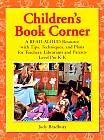
Review of CHILDREN’S BOOK CORNER: A READ-ALOUD RESOURCE WITH TIPS, TECHNIQUES, AND PLANS FOR TEACHERS, LIBRARIANS AND PARENTS LEVEL PRE-K-K

Bradbury, Judy. 2003. CHILDREN’S BOOK CORNER: A READ-ALOUD RESOURCE WITH TIPS, TECHNIQUES, AND PLANS FOR TEACHERS, LIBRARIANS AND PARENTS LEVEL PRE-K-K. Westport, CT: Libraries Unlimited. ISBN 1-59158-048-X

Judy Bradbury has to her credit a set of handbooks geared toward helping teachers, librarians, and parents in their quest for great read-alouds. This series covers Pre-K through the sixth grade. For the purpose of this review, the Pre-K - Kindergarten volume is referenced. CHILDREN’S BOOK CORNER includes lesson plans for fifty-three different picture books with copyrights ranging from 1942 to 2002. Also included are “pull-out pages” for parents. These pages include tips for parents as well as lists of additional theme-related, age-appropriate trade books. These lists are organized not only by subject, but also by type of book. This includes wordless, poetry and teacher resource books.

This book’s strongest asset is the sheer number of read-aloud lesson plans included. With fifty-three stories, one could read a story per week for a whole year! These lesson plans use classic titles such as GREEN EGGS AND HAM by Dr. Seuss. Bradbury also includes more contemporary books, including Amy Hest’s KISS GOODNIGHT. These lesson plans include critical pieces of information: knowing how long a story takes to read; pre-reading activities used to access children’s prior knowledge; techniques to use while reading the story; follow-up discussion questions and activities; and paired titles (“another book about…is…”). Beyond these thoughtful lesson plans, the author provides a brief description of the elements of a good picture book. In addition, children’s book awards and book review resources, such as The Horn Book Magazine, www.ala.org, and Jim Trelease’s THE NEW READ-ALOUD HANDBOOK, are listed.

Though a useful resource, CHILDREN’S BOOK CORNER has its weaknesses. For example, the copyright on many of the picture books referenced are old—some as old as 1942 (THE RUNAWAY BUNNY by Margaret Brown). While the majority of the books are not 66 years old, most titles are pre-1990. Another of the weaknesses has to do with the photographs included in this resource. Often, there is an unclear connection between the read-aloud plans and the adjacent photos. In one instance, the photographs show an adult and child reading ROSIE’S WALK. However, the photographs are adjacent to the read-aloud plans for BOOTSIE BARKER BITES. The lesson plan for ROSIE’S WALK is later in the book. Perhaps it is because the publisher did not acquire permission to print the covers of these books, necessitating the use of other types of photographs. In my opinion, this particular weakness provokes an amateurish impression. It’s as though the publisher was too lazy to procure permission to use the front covers for the rest of the titles.

Other weak points in this book are not what it includes, rather what it excludes. CHILREN’S BOOK CORNER lacks consistent and complete bibliographic information among the read-aloud titles. Bradbury includes the title, author, illustrator and publisher for each title. Yet, most titles lack the copyright date and none have ISBNs. Other omissions include consistent incorporation of front cover pictures, paired book suggestions, and the books’ classification, i.e. whether a book is Easy or Nonfiction. While the call number might be considered superfluous or an unrealistic expectation, knowing the type of book would be helpful in terms of searching for it. For example, it is unclear if I LOVE TRAINS! is found in the Easy or Nonfiction section of a library or bookstore.

Bradbury is careful to include a complete citation for each book for which a front cover picture is shown. The acquisition of publisher permission is made clear by the consistent use of the phrase “used with permission.” A formal citation for each read-aloud book, however, is not provided. The bibliographic information which is provided is in a table preceding each lesson plan. There is no formal bibliography anywhere in the resource.

The informal, conversational voice makes CHILDREN’S BOOK CORNER easy to read and understand. The book is broken into manageable sections which are delineated by intended audience: teachers and librarians, parents or both. Non-professional educators need not worry about the use of technical terminology nor confusing educational strategies. The teacher/librarian and parent sections contain duplicate information, each with an audience-specific tone. Bold headings facilitate the location of specific information. Another helpful access feature is the inclusion of four different indices. Readers can search by subject, title, author, and illustrator. Bradbury also provides an appendix of “…books too good to miss (but-wouldn’t-fit-in-the-main-section).” These titles are arranged by topic.

This resource speaks to a wide audience—virtually anyone who works with young children. All teachers who work with preschool through kindergarten-aged children would benefit from the information in this book. For librarians who have Easy collections in their libraries, this is an essential title. Finally, parents, grandparents, babysitters—in effect any caregiver of young children—could use these lesson plans to make story time a richer learning experience.

This resource is highly recommended for teachers, librarians, caregivers and parents of children ages 2-6.

Thursday, April 17, 2008

Review of THE GREAT REDWALL FEAST

Jacques, Brian. Christopher Denise. (Ill.) 1996. THE GREAT REDWALL FEAST. New York: Puffin Books. ISBN 0-329-21714-3

Of the fifteen plus Redwall books, this one is atypically light-hearted. Written in rhyming prose, Brian Jacques tells a story of abbeymice preparing a surprise feast for the abbot—also a mouse. Luckily for the residents of Redwall, the abbot goes on an unexpected, long walk. As it turns out, he knew all along about the surprise and was intentionally giving the devoted abbeymice an opportunity to prepare “in secret.” Though apparently occurring in medieval times, THE GREAT REDWALL FEAST has no specified era. The setting, the Redwall abbey, is most likely in a fantastic version of Britian. This may be supposed by the dialect reflected in the text, for example using “noice” for nice and “marm” for ma’am. Also, the illustrations show a great castle abbey in a countryside reminiscent of western Europe. The writing style makes this prose difficult to read aloud and tedious to read silently. The target audience, grades K-3 are not likely to have the patience to wade through this lengthy picture book. Older readers may be put off by the juvenile and merry tone of the illustrations and story.

While the illustrations in this story are geared for readers grades K-3, the prose is written at a much higher interest level.

Tuesday, April 15, 2008

Review of THE LIGHTNING THEIF first in the series Percy Jackson and the Olympians

Riordan, Rick. 2005. THE LIGHTNING THEIF. New York: Hyperion Books for Children. ISBN 0-786-85629-7

Having dyslexia and Attention Deficit Disorder isn’t exactly the description of your typical hero with super powers. However, Percy Jackson just happens to fit this description. With a god for a father and mortal as a mother, our hero is a demi-god. His character is scrutinized throughout the story by the other players: is he worthy of his position? Time and again, Percy’s bravery and intelligence are tested. His friends, Annabeth and Grover, accompany him on his quest. Each of the trio brings his or her own special qualities to the journey. Annabeth is smart and brave. Grover, a satyr, has an innate sense of direction and is a devoted friend. Together they seek Zeus’ lightning bolt and the thief who stole it. On the quest, tests similar to those experienced by Odysseus must be passed. Riordan makes continual references to Greek mythology and writes in third person, keeping the reader abreast of Percy’s thoughts. With battles including monsters and gods, this ‘good triumphs over evil’ book engages readers and maintains an energetic pace with not a dull moment.

Also in this entertaining series are THE SEA OF MONSTERS (#2); THE TITAN’S CURSE (#3); and, released on May 3, 2008, THE BATTLE OF THE LABYRINTH (#4).

This high fantasy novel—and the others in the series—are very highly recommended for readers grades 5-8.

Monday, April 14, 2008

Review of BABYMOUSE: QUEEN OF THE WORLD! and BABYMOUSE: OUR HERO


Holm, Jennifer L. 2005. BABYMOUSE: QUEEN OF THE WORLD! New York: Random House. ISBN 0-375-93229-1

Holm, Jennifer L. 2005. BABYMOUSE: OUR HERO. New York: Random House. ISBN 0-375-93230-5

Babymouse is a space explorer, a private eye, a soldier and a queen. Ok, maybe she’s just an ordinary mouse trying to make it in elementary school. Daydreaming is how Babymouse makes the best of rotten, “typical” situations. With the help of her faithful and supportive best friend, Wilson the Weasel, Babymouse makes it through the hard times and always realizes she’s lucky to be herself. In QUEEN OF THE WORLD!, Babymouse wants to be invited to the slumber party of the ever popular but rude, Felicia Furrypaws. When she discovers the slumber party isn’t as fun as she’d thought it would be, Babymouse goes to Wilson’s house with a humble apology and realizes it is with her best friend that she feels like a queen. In OUR HERO, Babymouse is forced to face her fear of dodgeball in gym class. Ultimately, she finds her inner strength when her friend is hit with the ball by Felicia Furrypaws. “That’s it,” she mutters as she slides across the floor, snatches up the last ball, and “fwacks” Felicia to score the winning shot. These Cinderella moments are typical in the Babymouse series. That’s part of what makes them fun to read. The playfulness is enhanced by frequent conversations between the narrator and Babymouse. Though at times confusing, the irregular format of the pages also gives the book a lively feel. In Babymouse, Jennifer Holm brings a girl-focused graphic novel series to collection development plans. In such a male-dominated genre, this is a wonderful path to travel.

This graphic novel is highly recommended for readers grades 2-5.

Sunday, April 13, 2008

Review of THE CHILDREN OF GREEN KNOWE

Boston, L.M. 1955. THE CHILDREN OF GREEN KNOWE. New York: Harcourt, Inc. ISBN 0-15-202468-9

Toseland must go to live with his great-grandmother, Mrs. Oldknow, for the winter break from school. Though they have never met, it is obvious they immediately get along and are glad to have each other. On their first encounter, Mrs. Oldknow tells Tolly, “So you’ve come back!” she said, smiling, as he came forward, and he found himself leaning against her shoulder as if he knew her quite well.” Tolly has always been a bit of a loner—especially since his mother died. With no siblings, he is eager to find playmates. His innate sense of curiosity draws him into the mysterious happenings in his grandmother’s home and she patiently and lovingly encourages his exploration and discovery. This third-person omniscient narrative fantasy is a ghost story, though not in a typical sense. Rather than the reader and characters being afraid of the ghosts, we are all eager for them to show themselves. Mrs. Oldknow encourages the ghosts’ appearance by giving Tolly some of their belongings and telling stories of when they were alive. The identities of the ghosts is one of the most enjoyable discoveries of this novel, and thus shall not be divulged here. Boston uses formal speech and narrative to tell the story of a lonely child discovering the mysteries of his family’s manor. This manor is described in incredible detail—the smells of the stable, the topiary garden, the bedrooms and living rooms, and the many animals which roam about. Though a bit slow moving, the reader cannot help but “see” the story unfold through Boston’s descriptive writing style.

This story is recommended for readers grades 3-6.